Why We Started The Label Rule
The front of a food pack is marketing. The back is information. Here’s why we read one ingredient at a time, and the simple rule we use to do it.
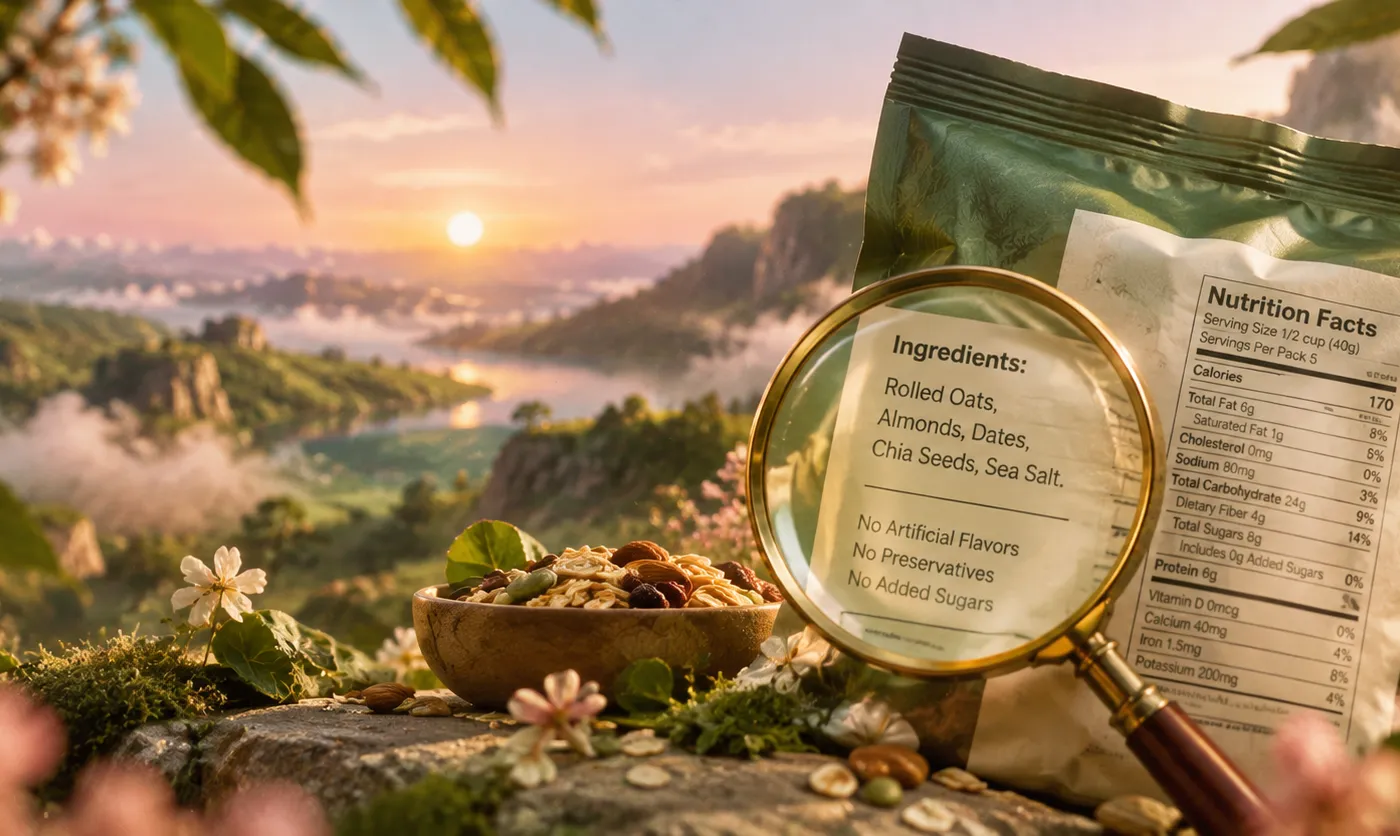
Pick up almost any packaged food and you’ll find two stories printed on it. The front tells you how to feel: natural, wholesome, high in protein, made with real fruit. The back tells you what’s actually inside. Most of us read the first story and skip the second.
The Label Rule is our attempt to reverse that habit. It’s a weekly series in which we pick a single ingredient you’re likely to find on a label, and explain, calmly and with sources, what it is, why it’s there and what the evidence says about it.
~500
The rule itself
It’s short enough to remember in a supermarket aisle:
Turn the pack over. Read the ingredients before you believe the claims.
That’s it. It isn’t a diet, a list of banned foods or a purity test. It’s a reading habit, one that puts you back in charge of the decision.
Why the back of the pack matters
In the United States, packaged foods must list their ingredients in descending order of predominance by weight. The first ingredient is the one there’s most of; the last is the one there’s least of. That simple regulation turns the ingredient list into one of the most useful pieces of information you’ll ever get about a food, for free.
The Nutrition Facts panel next to it adds the numbers: serving size, calories, and the amounts of added sugars, sodium, fiber and protein. The US Food & Drug Administration’s own guidance encourages people to use the percent Daily Value as a quick reference: 5% or less of a nutrient per serving is considered low, and 20% or more is considered high.
Front-of-pack wording, by contrast, is much more flexible. A claim like “made with whole grains” can be true of a product in which whole grains are a minor ingredient. “No added sugar” can sit on a food that’s naturally very high in sugar. None of this is necessarily dishonest, but it is selective. The back of the pack is where the full picture lives.
Enjoying this? Get one every Sunday.
One evidence-based email on healthspan and nutrition. No hype, no miracle cures.
Every Sunday. Free. Unsubscribe in one click.
Why one ingredient at a time
Food labels have become harder to read, not easier. Much of the modern food supply is what researchers call ultra-processed: industrial formulations made largely from refined ingredients and additives rarely used in home kitchens. The NOVA classification system, developed by researchers at the University of São Paulo, is one widely used way of grouping foods by their degree of processing.
There’s a good reason to take this seriously. In a tightly controlled inpatient trial run by the US National Institutes of Health, adults ate an ultra-processed diet for two weeks and a minimally processed diet for two weeks, eating as much or as little as they liked. On the ultra-processed diet, they ate around 500 more calories per day and gained weight; on the minimally processed diet, they lost weight. It was a small study of 20 people, and it doesn’t tell us which specific ingredients matter. But it shows that how food is made can influence how much of it we eat.
That’s exactly why long ingredient lists can feel overwhelming. So we slow down. One ingredient, one week, properly explained.
What we promise in every Label Rule
Each piece in the series answers the same three questions:
- What is it? Where the ingredient comes from and how it’s made, in plain language.
- Why is it there? The job it does in the food: texture, sweetness, shelf life, colour, cost.
- What does the evidence say? What regulators have concluded, what the research shows in humans, and where the honest answer is “we don’t know yet”.
And we hold ourselves to a few rules of our own:
- A long chemical name is not evidence of harm. Many unfamiliar-sounding ingredients are well studied and unremarkable.
- A natural-sounding name is not evidence of safety. “Natural” is a marketing word, not a scientific one.
- Mouse studies are not human studies. We’ll tell you when a headline is based on animals, cells in a dish or a single observational study.
- Dose matters. The amount in a food is often more important than the ingredient’s mere presence.
What this series is not
The Label Rule isn’t about fear. The World Health Organization’s advice on a healthy diet is refreshingly unexciting: plenty of vegetables, fruit, legumes, nuts and whole grains; less salt, less free sugar and fewer industrially produced trans fats. No single ingredient on a label will make or break your health.
But small, repeated choices add up over decades, and that’s what healthspan is really about. Reading labels well is one of the cheapest, most practical skills you can build for the long run.
How to use it
Next time you shop, pick one product you buy regularly and read the back. Notice the first three ingredients, check the added sugars and sodium, and see whether the front-of-pack claims still feel the same.
Then come back each week. We’ll take the ingredients one at a time.
Get the next one in your inbox.
New pieces like this one every week, on nutrition and more. Always with sources.
Every Sunday. Free. Unsubscribe in one click.
Sources
Every claim in this article traces back to one of these.
- U.S. Food & Drug Administration: How to Understand and Use the Nutrition Facts Labelfda.gov ↗
- 21 CFR 101.4: Food; designation of ingredients (ingredients listed in descending order of predominance by weight)ecfr.gov ↗
- Hall KD, et al. Ultra-Processed Diets Cause Excess Calorie Intake and Weight Gain: An Inpatient Randomized Controlled Trial of Ad Libitum Food Intake. Cell Metabolism, 2019.doi.org ↗
- Monteiro CA, et al. Ultra-processed foods: what they are and how to identify them. Public Health Nutrition, 2019.doi.org ↗
- World Health Organization: Healthy diet (fact sheet)who.int ↗
Educational content, not medical advice. This article is for general information and is not a substitute for advice from a doctor, dietitian or other qualified professional. Please talk to your clinician before changing your diet, medication or exercise routine. Spotted an error?Tell us.